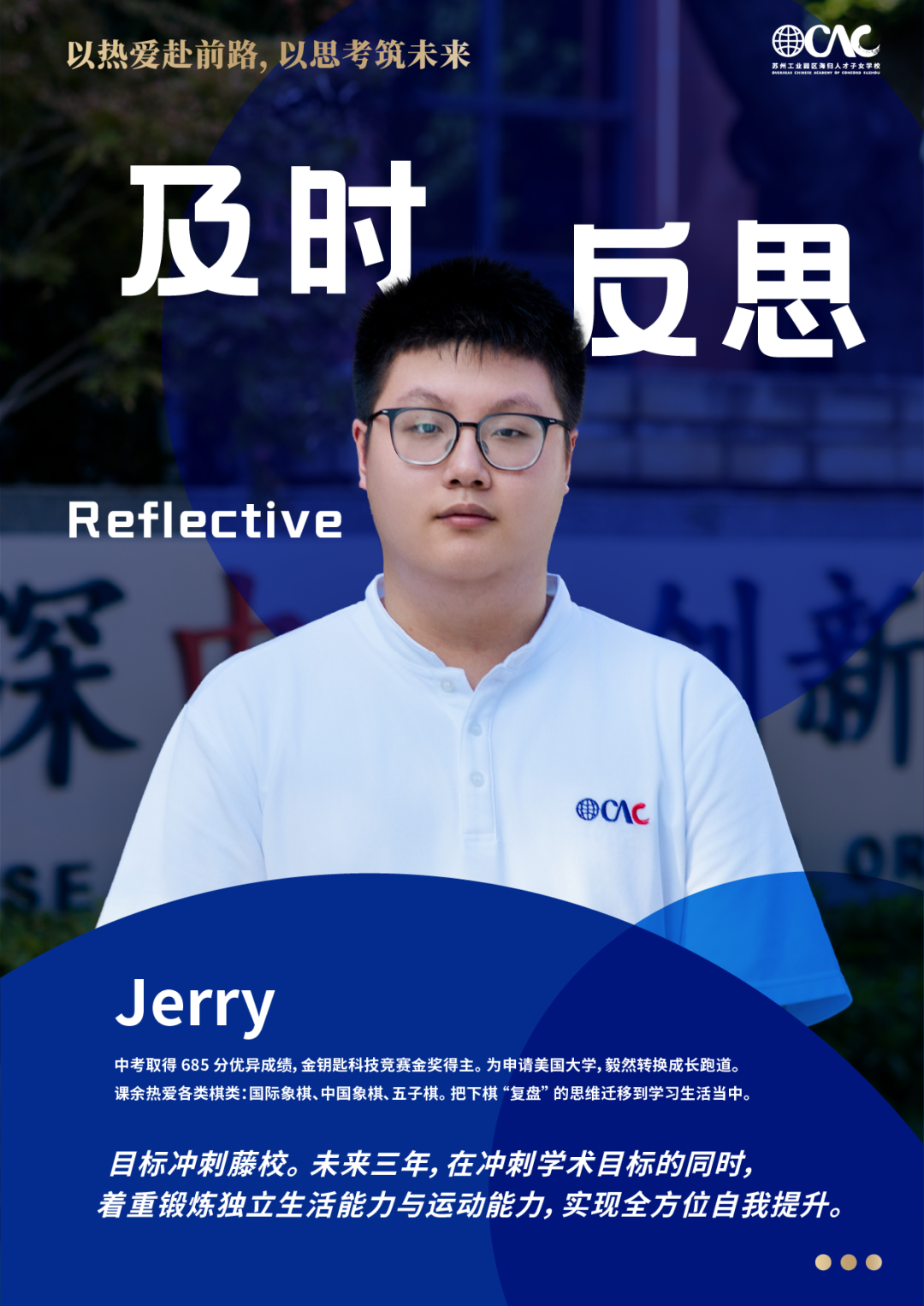
That is Jerry, a top scorer on the high school entrance exam.
"Because I've been caught in the rain myself, I want to hold an umbrella for others."
Ariel, whose interests span many fields, is considering whether to shift her future academic focus from neuroscience to psychology.
"At OCAC, being an introvert just doesn't seem possible. I'll probably have to keep being an extrovert and keep pushing forward."
That is how Emma, a recipient of the school's Research Grant, puts it.
"Stay true to who you are, keep your composure and sense of humor, and never give up the things you love."
After years as a class monitor, Andy values "being an interesting person" more than the numbers on a report card.
…
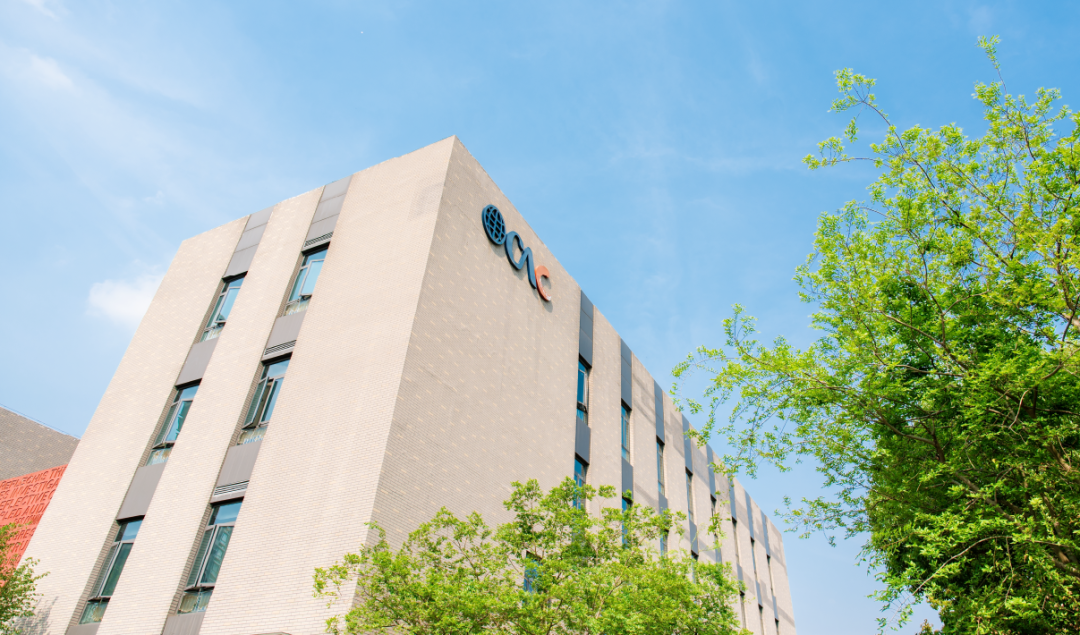
They are Grade 10 students who have just begun a new chapter at OCAC. Some walked away from the prestige of a 685 high school entrance exam score; some transferred from the AP system; and some have been at OCAC for years, deeply familiar with the school yet still full of anticipation for high school life…
To describe them simply as "outstanding" or "top students" would be far too easy.
At the start of this new school year, we sat down with several of them to talk about choices, adjustment, and the people they hope to become three years from now.
After hearing their stories, phrases like "youth full of promise" and "a bright future ahead" may begin to feel tangible. They are here for far more than an impressive transcript.
Jerry:
With a 685 Entrance Exam Score, He Chose a Different Path
At a Glance:
685 on the High School Entrance Exam / Gold Award, Golden Key Science & Technology Competition / Ivy League Goal
With a score of 685 on the high school entrance exam, Jerry finished middle school with an academic record that gave him plenty of options. His plan is to attend university in the United States, so the IB naturally became his first choice.
The IB was also a key reason he chose OCAC. Its well-established IB programme and comprehensive transition courses help students coming from the public-school system adapt smoothly.
Jerry has strong confidence in his academic ability. Even in a demanding public-school environment, he found studying relatively easy. He is the kind of high-achieving student who values efficiency above all else, with consistently strong performance across every subject and no obvious weak spots.
Outside the classroom, his favourite pastime is chess in all its forms: international chess, Chinese chess, Gomoku, and more.
Chess is all about reviewing the game afterwards, and Jerry has gradually carried that habit into other parts of his life. "If I had to choose one of the ten IB Learner Profile attributes that represents me best, I would choose 'Reflective.'"
Encouraged by his family, Jerry chose to become a boarding student. The next three years will not only be a period of aiming for Ivy League universities, but also a time for him to strengthen his independence, daily living skills, and physical fitness.
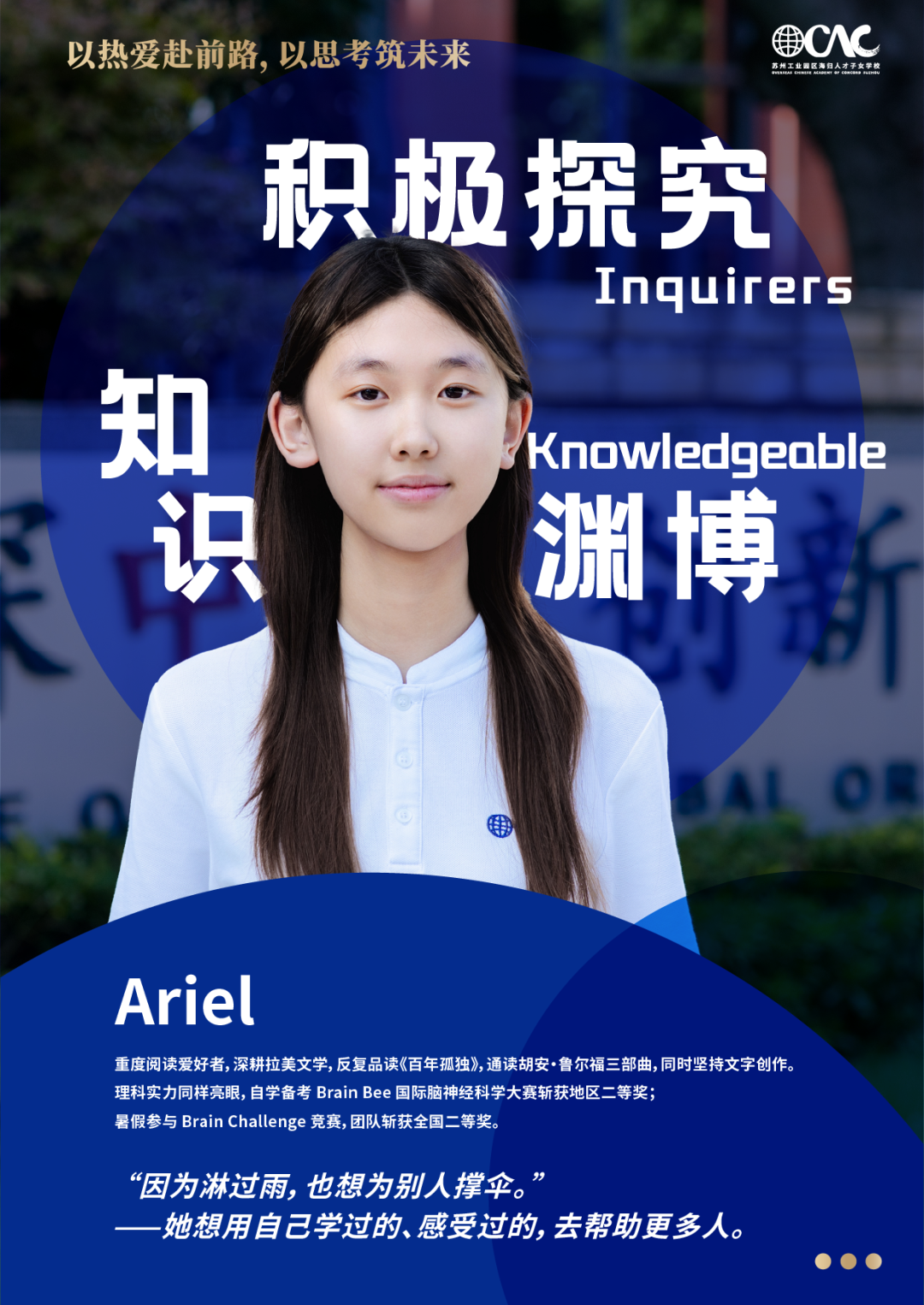
Ariel:
From AP to IB, Finding a Better Way to Express Herself
At a Glance:
Regional Second Prize, Brain Bee / National Second Prize, Brain Challenge / Transferred from AP to IB / Latin American Literature Enthusiast
Ariel transferred to OCAC in Grade 9, and this is now her second semester here. She previously studied the AP curriculum at an international school. What drew her to OCAC was the inclusiveness of the IB: "It embraces your ideas through different kinds of extended projects."
She is an avid reader, with a particular love for Latin American literature. She has read One Hundred Years of Solitude three times and has not missed a single book in Juan Rulfo's body of work. And she does not only read — she writes as well. We hope to see her own work someday.
Ariel's interest in biology also goes back a long way. She independently prepared for the Brain Bee neuroscience competition and won second prize at the regional level. This summer, she also took part in the Brain Challenge, where her team won second prize nationally.
What is most striking about Ariel is the way she thinks about her future. In middle school, choosing neuroscience was partly influenced by career considerations. Now, however, she feels she may be more drawn to the humanities or psychology. "Because I've been caught in the rain myself, I want to hold an umbrella for others." She hopes to use what she has learned and experienced to help more people.
In three years, she hopes to be "a better communicator and a more caring person." As she carefully reconsiders her academic direction, she has clearly already taken the first step.
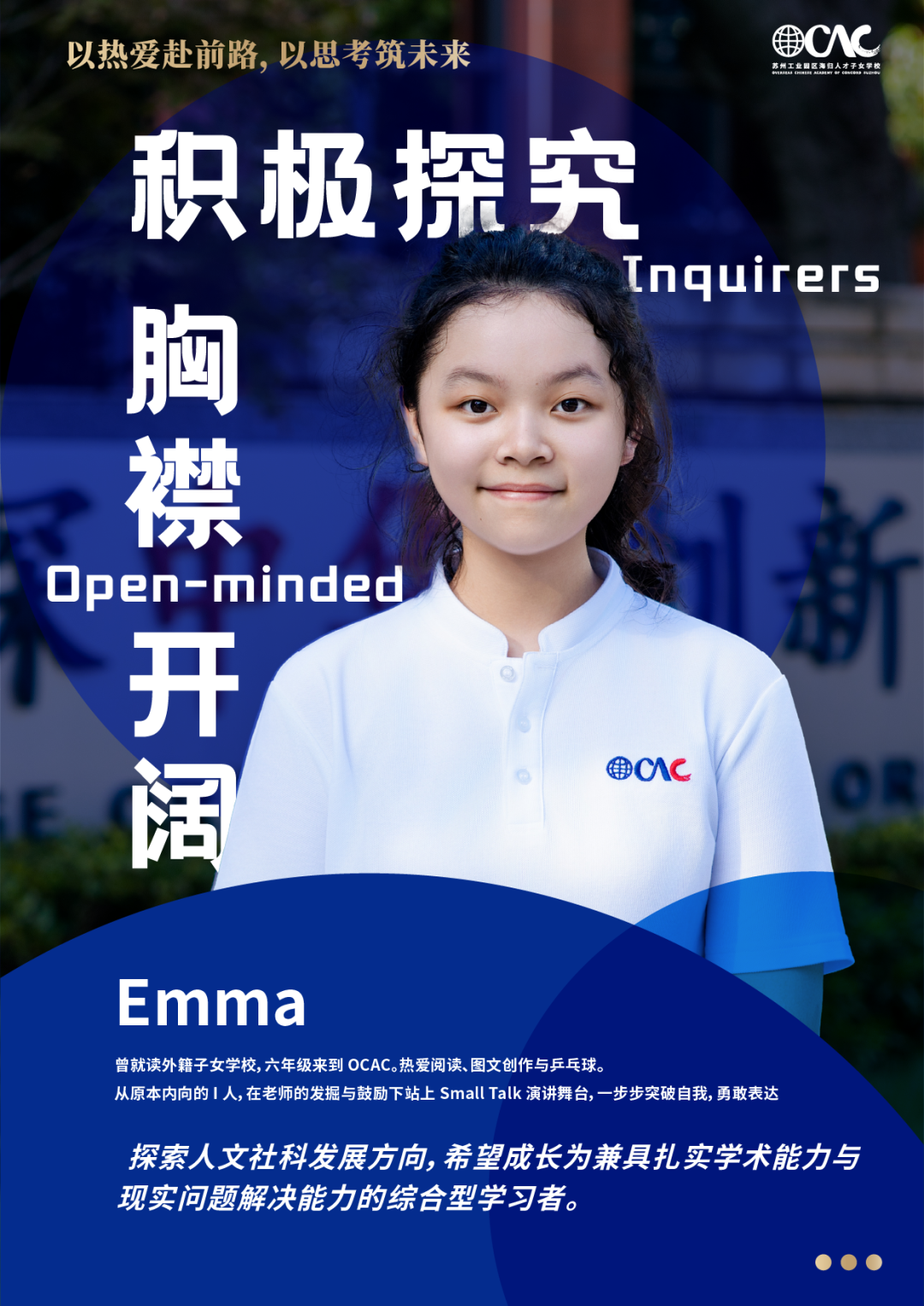
Emma:
A Research Grant Recipient Who Feels "Seen" at OCAC
At a Glance:
Research Grant Recipient "Forced" to Become an Extrovert / Interested in the Humanities and Social Sciences / Wants to Become an Independent Thinker
At the opening ceremony a few days ago, Emma received an RMB 80,000 research grant from the school. It was a fitting recognition of the curiosity and persistence she has shown in inquiry and research.
She jokes that at OCAC, it is almost impossible to remain a quiet introvert — at least for her. Even teachers she does not know may notice her reading in the library and encourage her to go on stage and share her thoughts.
"Things like this happen all the time at OCAC — there are many thoughtful teachers who will inspire and encourage you."
"Being an introvert just doesn't seem possible. I'll probably have to keep being an extrovert and keep pushing forward."
The two IB Learner Profile attributes Emma identifies with most are "Inquirers" and "Open-minded." She is curious about everything and is able to understand and respect people from different backgrounds and with different viewpoints.
What kind of person will Emma be three years from now?
She hopes to become more of a "Thinker" and more "Reflective." That goal grew out of an interview during a study trip to Hulunbuir. When she asked residents of a border village about the negative impacts of tourism, the answer she received was, "There aren't any at all."
She did not believe that answer, of course. But after talking with her parents and teachers, she began to realise that there could be many complex reasons behind the villagers' silence…
"I hope that three years from now, I won't need someone else to guide me before I can think this deeply on my own."
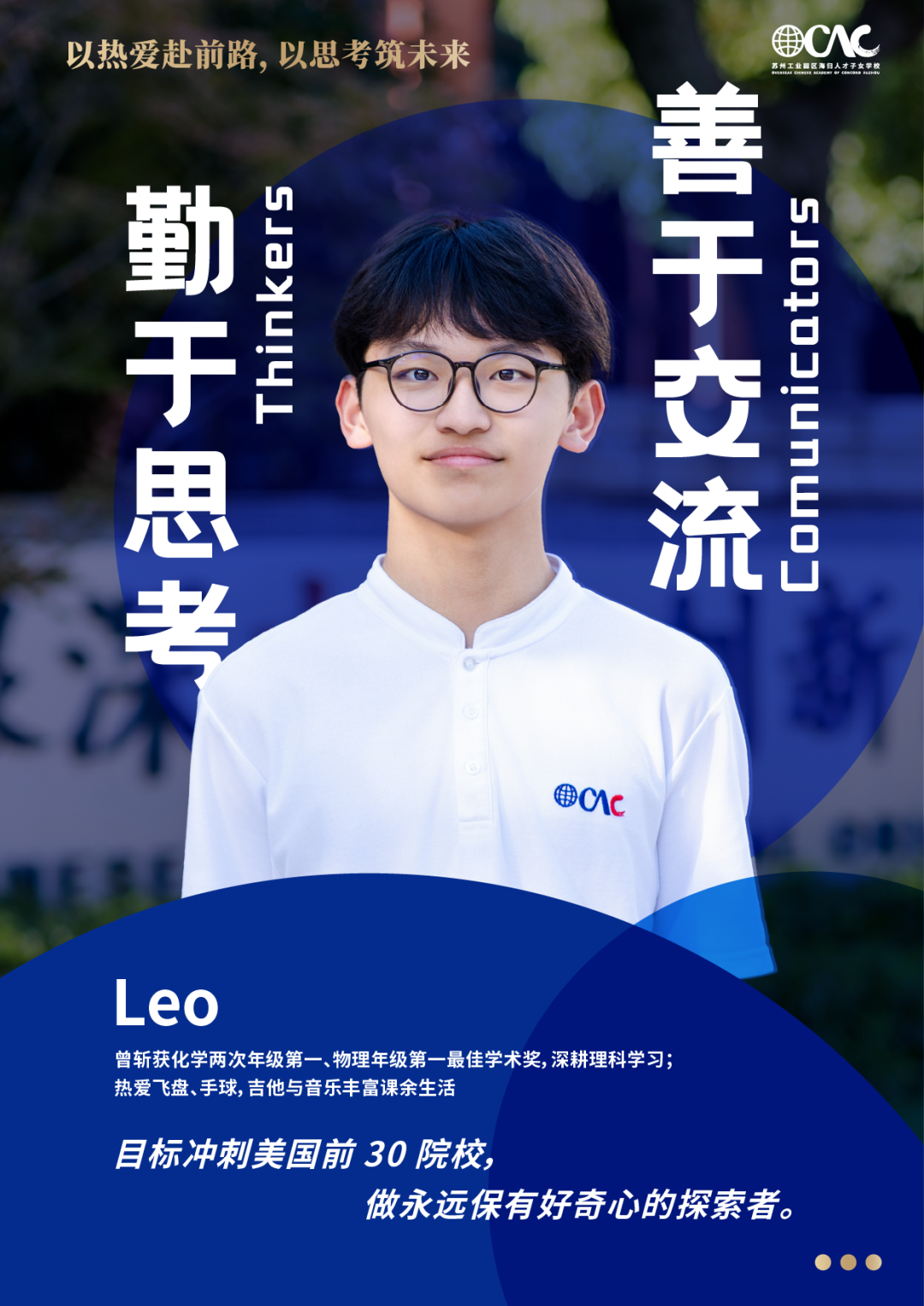
Leo:
Becoming Someone Who Never Loses His Curiosity
At a Glance:
Top STEM Student / Targeting a Top-30 U.S. University in Medicine or Life Sciences / Wants to Remain Curious for Life
Two first-place finishes in chemistry and one in physics — that was Leo's academic record in Grade 9.
He joined OCAC in Grade 7, went through the MYP and IGCSE stages, and found the academic direction that truly interests him here.
After entering high school, he noticed the difference immediately. The teaching team is stronger, many new projects and activities have been added, and "even the laboratories have been upgraded." His class has also welcomed a group of highly capable new students. "I hope we can inspire one another and improve together."
His goal is clear and firm: he plans to focus on chemistry and biology in the IB, aim for a top-30 university in the United States three years from now, and continue into medicine or the life sciences.
But Leo expects even more of himself. Beyond building a strong academic foundation, he wants to learn how to design experiments independently, read research literature efficiently, and develop consistent time-management and emotional-regulation skills.
"Always stay curious" — that is his most important expectation for himself.
Today, he already sees himself as a "Thinker" and a "Communicator." He likes digging into the principles behind things and enjoys explaining problems to his classmates.
Three years from now, he hopes to add two more qualities to that list: "Open-minded" and "Risk-taker":
"I want to step out of my comfort zone more actively, take on things I'm not completely sure I can do, and learn to accept imperfections in the process with calmness."
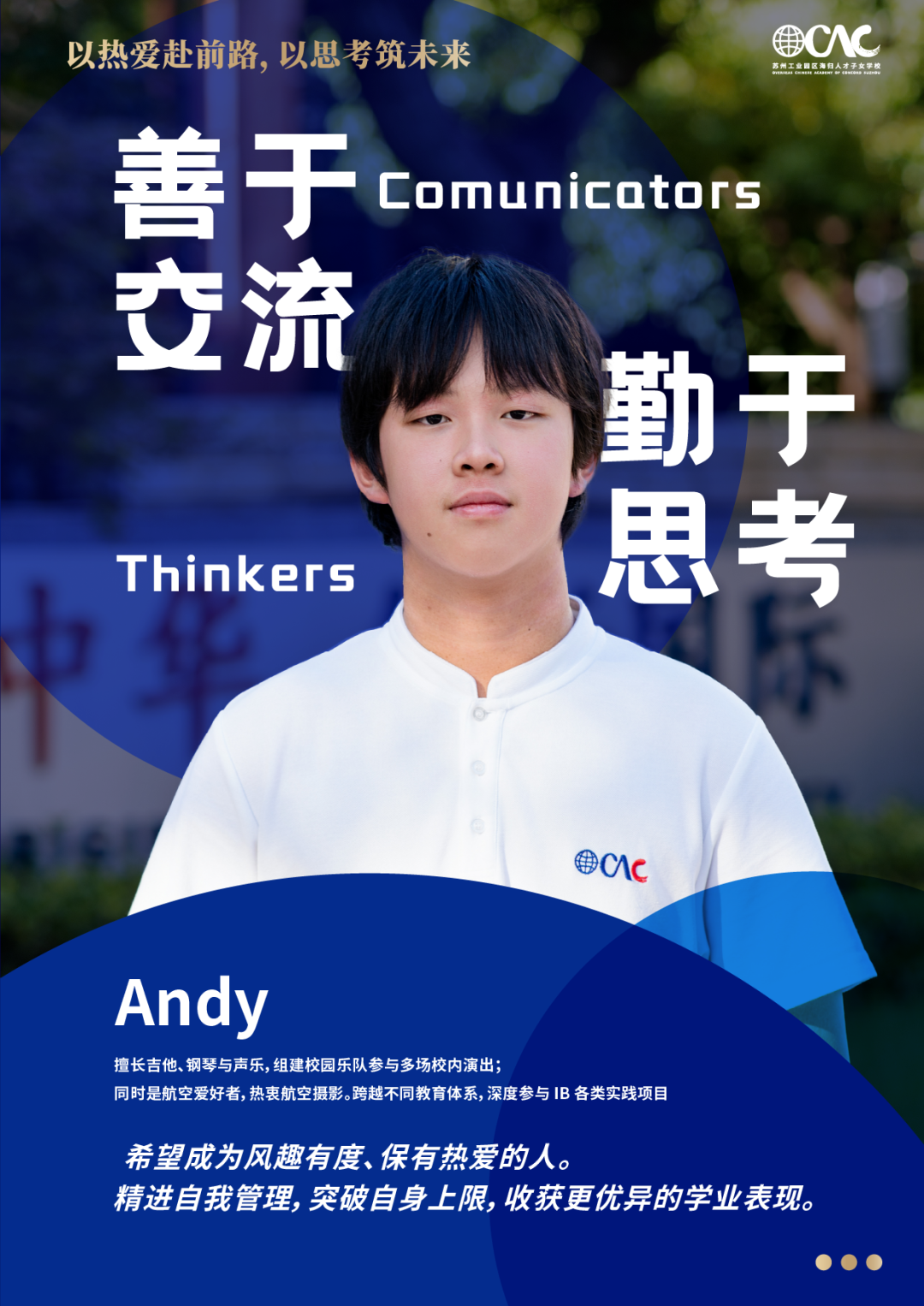
Andy:
Be an Interesting Person — and Work a Little Harder, Too
At a Glance::
Former Band Member / Aviation Photography Enthusiast / Long-time IB Student / Years of Experience as Class Monitor / Wants to Be Both Interesting and More Hard-working
Andy is a true OCAC veteran. He transferred from a public school in Grade 4, went through the CP programme and the PYP Exhibition, and, as he puts it, "didn't miss a single major IB project."
He loves music and plays guitar and piano, as well as singing. He has formed a band and performed at school many times. He also has a particularly distinctive hobby: aviation photography. "Whenever I have free time, I'm at the airport, keeping the planes company."
The biggest change he felt after entering high school was "more psychological pressure." "I could be pretty relaxed in MYP, but the moment Grade 10 started, everything suddenly became intense." He speaks openly about the worry and anxiety that come with university applications.
But when he talks about his new class, his tone immediately becomes lighter: "cheerful and lively." There are many new faces, and everyone brings energy.
One moment in PE class left a particularly strong impression on him. Returning students eagerly encouraged the newcomers to join group activities. Although they barely knew one another yet, there was already a kind of unspoken chemistry.
Andy has served as a class monitor for many years. He gets along well with classmates, enjoys helping others, and strongly embodies the IB qualities of being a "Communicator" and a "Thinker."
As he prepares to focus more deeply on academics in high school, he hopes to become more "Knowledgeable" — "more diligent, work harder, push beyond my limits, and achieve better results."
More importantly, though, he still wants to become "an interesting person": "Stay true to who you are, keep your composure and sense of humor, and never give up the things you love."
The story has only just begun.
You may have noticed that what these OCAC students share goes far beyond academic excellence. They also possess a clear sense of self and the courage to make their own choices.
What will a community made up of students like these go on to create? We look forward to finding out.
Three years from now, when we return to this article, perhaps we will see that they have grown into the people they hoped to become.